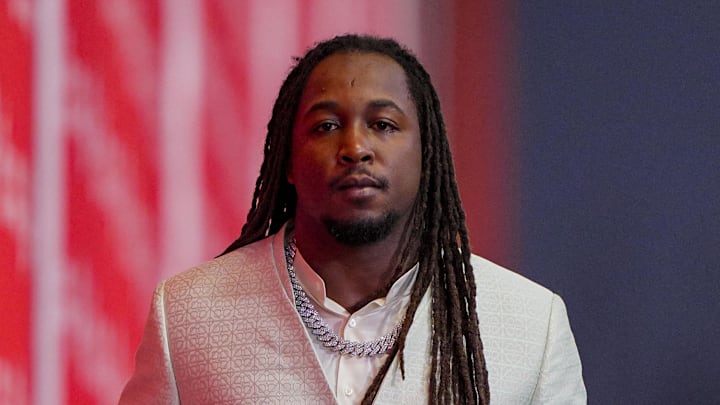
KANSAS CITY — As the Kansas City Chiefs finalize their offseason roster, one lingering question remains: could Kareem Hunt still play a pivotal role in a reimagined backfield, even amid a major overhaul aimed at reshaping the ground game for 2026?
After a whirlwind offseason of free agency acquisitions and draft maneuvers, the Chiefs have turned over nearly every layer of their running back depth chart, signaling a commitment to speed, versatility, and long-term security at a position that has historically been inconsistent.
Yet despite the influx of young talent and fresh faces, the conversation about Hunt remains relevant, largely because of his proven ability in short-yardage and goal-line situations, areas where Kansas City historically seeks reliability and toughness to complement their explosive playmakers.
As of press time, Kareem Hunt is a free agent, able to sign with any NFL team, though speculation abounds regarding whether his nine-season career has begun to wind down or if teams are hesitant to commit to a back approaching his 30s with a heavy workload history.
While Hunt may no longer be the spry, dynamic rookie who finished second in Offensive Rookie of the Year voting in 2017, his resume still includes tangible accomplishments that offer considerable situational value for a team like the Chiefs, particularly when short-yardage conversions are critical to sustaining drives.
Last season, Hunt led Kansas City in rushing with 611 yards and eight touchdowns, demonstrating his continued productivity in a specialized role, and he has accumulated 15 rushing touchdowns over the past two seasons since returning from a five-year tenure with the Cleveland Browns.
During his homecoming to Arrowhead Stadium, Hunt repeatedly pushed through stacked defensive fronts in goal-line scenarios, converting attempts at an 85 percent success rate on third or fourth down plays, the highest in the NFL, underscoring his ability to execute when the margin for error is minimal.
This situational prowess is exactly the type of skill the Chiefs’ backfield currently lacks, even after bolstering the roster with new talents, and it highlights a persistent strategic gap between dynamism in open-field play and a battering ram for short-yardage scenarios.
Kansas City’s offseason additions have been aggressive and focused. Kenneth Walker III was acquired in free agency, signaling the team’s intent to emphasize a ground-oriented approach that complements Patrick Mahomes’ aerial attack, while injecting explosiveness and threat in multiple dimensions.
The Chiefs also signed Emari Demercado from the Arizona Cardinals, adding an athletic, versatile back capable of stretching defenses horizontally and vertically, providing a new layer of offensive flexibility that was missing in both 2024 and 2025 campaigns.
Additionally, the team invested a fifth-round draft pick on Emmett Johnson of Nebraska, a productive and well-rounded runner whose skills can supplement Walker and Demercado, giving Kansas City a depth chart featuring a combination of elite ceiling, situational reliability, and long-term developmental potential.
Despite this impressive trio, one element remains absent: a true short-yardage specialist, a back who can reliably absorb goal-line, third-and-one, and heavy-contact situations, pushing through defensive lines to maintain possession and sustain drives without risk of turnover or injury.
Historically, the Chiefs maintained a fullback to serve in this precise capacity, creating a battering-ram role that allowed their dynamic backs to thrive in open-field situations without exposure to high-contact, high-pressure downs, a strategy that yielded consistent offensive production.
Kareem Hunt fills this void, offering a familiar and proven skill set that complements the Chiefs’ offensive philosophy, particularly in scenarios where explosive speed and open-field ability are less important than contact resilience, decision-making under duress, and ball security.
While Hunt’s role would no longer involve multi-down series or serving as a tandem to Isiah Pacheco, he could operate as a situational weapon, utilized in specific series where the risk-reward balance favors experience and physicality over long-term development or stamina.
The calculus for Kansas City extends beyond pure talent; roster construction is also an exercise in risk management, balancing injury contingencies, workload distribution, and matchup-specific strategies, all while maintaining enough flexibility to maximize Mahomes’ offensive efficiency.
In the context of a four-back rotation, Hunt’s presence could alleviate short-yardage concerns, giving the Chiefs a reliable option to protect critical downs, sustain drives, and strategically deploy Walker, Demercado, and Johnson in roles optimized for their explosive abilities.
Moreover, Hunt’s familiarity with the Chiefs’ system, coaches, and playbook significantly reduces the integration risk typically associated with free-agent acquisitions, allowing him to contribute almost immediately without the lengthy adaptation process often required for mid-career veterans.
The Chiefs’ decision-making also reflects an understanding of positional specialization in modern NFL offenses, where versatility and dynamism must coexist with situational reliability, particularly at running back, a position increasingly tasked with multi-dimensional responsibilities in both passing and rushing schemes.
Analysts have noted that Walker represents one of the most dangerous offensive weapons with the ball in his hands, capable of breaking games open in a single play, while Demercado offers explosive range, and Johnson provides balance and tandem capability, yet none can serve as a dedicated short-yardage enforcer.
Hunt’s inclusion, therefore, would complement the team’s multi-tiered backfield strategy, providing a short-yardage anchor while allowing the younger, faster, and more versatile backs to exploit defensive schemes and create explosive plays downfield.
While it remains unclear whether Hunt will re-sign with the Chiefs or explore other opportunities, his track record, situational success, and institutional familiarity make him a logical candidate to complete a backfield built for both high ceilings and low-risk stability heading into the 2026 season.
For fans, this scenario emphasizes a critical narrative: Kansas City’s backfield is no longer just about raw talent, but about balanced deployment and situational mastery, ensuring the team can handle all contingencies while maximizing offensive output in key moments.
Ultimately, the decision rests with GM Brett Veach and the coaching staff, weighing roster space, cap considerations, and the potential value of retaining a veteran like Hunt versus allocating resources to younger, more explosive options who may lack the short-yardage acumen Hunt consistently delivers.
Even in a reconstructed backfield featuring some of the league’s most promising talents, Hunt’s potential role as a situational, short-yardage specialist underscores the nuanced strategy that separates elite NFL offenses from average ones, highlighting the Chiefs’ commitment to precision in personnel management.
In conclusion, while the Chiefs have rebuilt a backfield capable of game-breaking plays, the presence of Kareem Hunt could serve as the critical final piece, offering situational reliability, veteran experience, and a strategic safety net to complement an otherwise dynamic offensive unit poised for the upcoming season.